
Occupations Overview
Our occupations data harnesses nationally representative data from the U.S. Census Bureau, along with details from the Bureau of Labor Statistics and Department of Labor, to give you everything you need to know about an occupation. All statistics can be viewed at the state-by-sex level (subject to data availability) — for example, selecting State=Virginia and Sex=Male shows statistics obtained using men living in Virginia who work in the selected occupation. See Methodology for the full data-quality details.
Note: This guide is written for Pro users. Non-logged-in and free users may not have all of these features. You can get Pro access by subscribing.
Overview
The occupations explorer can help you understand these facts about an occupation:
- The educational requirements, by seeing the real-life educational attainment of people working in it
- How pay evolves over the career
- The work-life balance people typically experience
- Clear paths on how to arrive at that occupation, by seeing the top majors that feed into it — and how pay varies by feeder major within that occupation
- The specific tasks, skills, and abilities the occupation requires, via interlinked BLS/DOL data
Browsing occupations
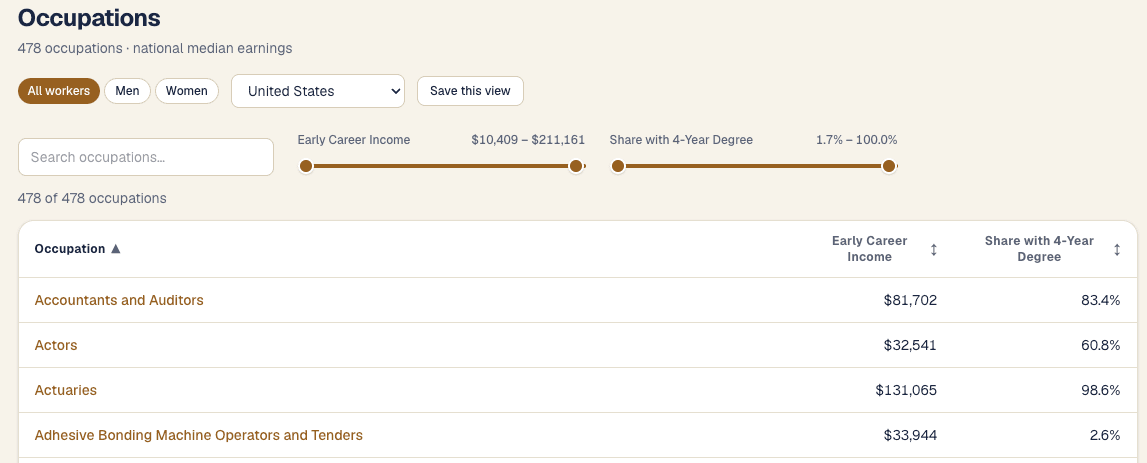
The /occupations page is the place to begin your search. You can search across our 478 occupations, and use the filters to restrict occupations by early-career income or educational attainment level. Click any occupation to see more details about it.
The occupation detail page
Selecting an occupation opens its detail page, organized into eight tabs:
- Overview — a summary of the occupation's key outcomes.
- Feeder Majors — the top majors held by people working in the occupation.
- Industries — the top industries the occupation is found in.
- Earnings — earnings trajectories by age.
- Education — the distribution of educational attainment within the occupation.
- Hours Worked — the distribution of typical weekly hours worked.
- Details — O*NET tasks, skills, and work abilities for the occupation.
- Resources — the BLS Occupational Handbook, related occupations, professional associations, and job boards.
Every tab can be broken down by state and sex — for example, to see the top feeder majors for women in Texas.
Overview
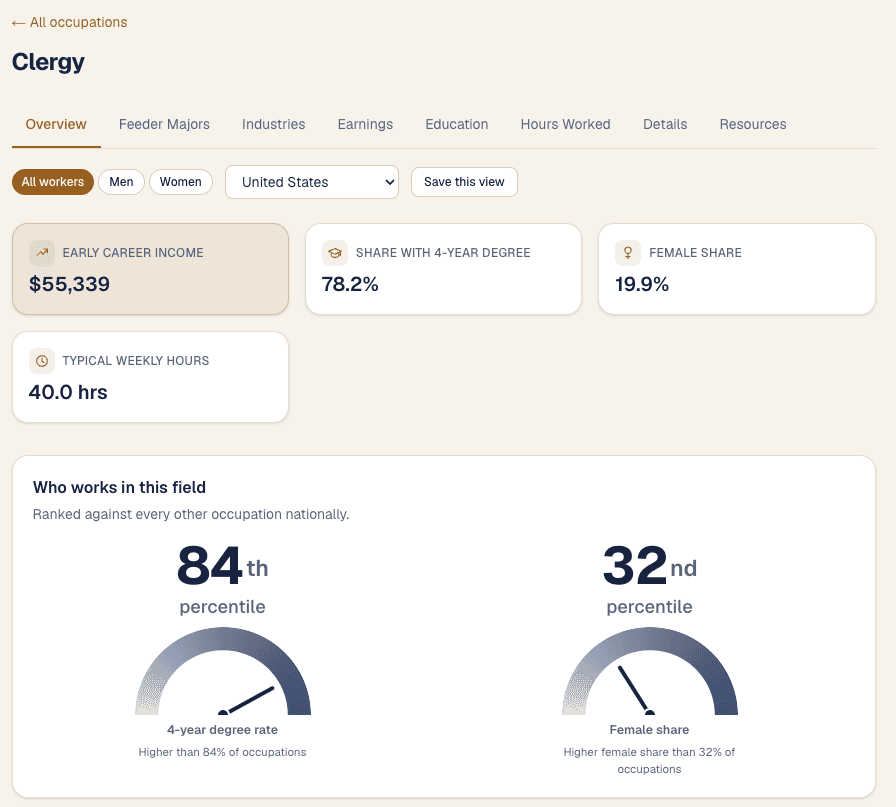
This tab summarizes the key information about the occupation. Early Career Income and Typical Weekly Hours are both medians. The percentile gauges help you assess how the occupation compares to others — within the selected sex and geography — by 4-year degree share and female share.
Feeder Majors
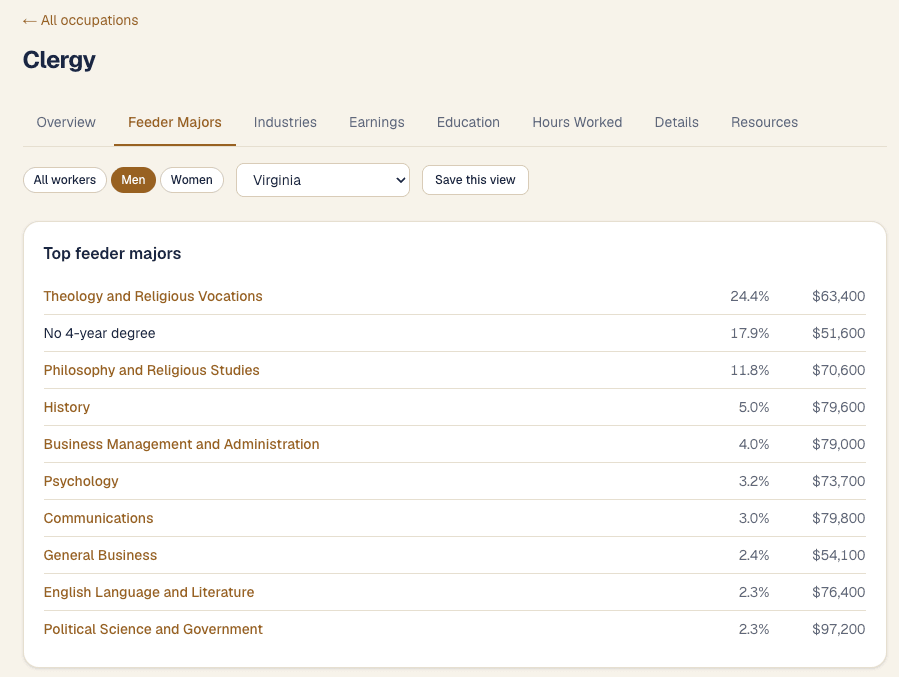
This tab lists the top 10 majors held by people working in this occupation (people without a degree are grouped under "No 4-year degree"), along with the share of people holding each major and how much people with that major earn while working in this occupation. This tab is useful for giving users a good idea of the pipelines into an occupation.
Industries
The Industries tab lists the top 10 industries the occupation is found in, including their share and earnings within the industry. The interpretation of the statistics is the same as for the Feeder Majors tab.
Earnings
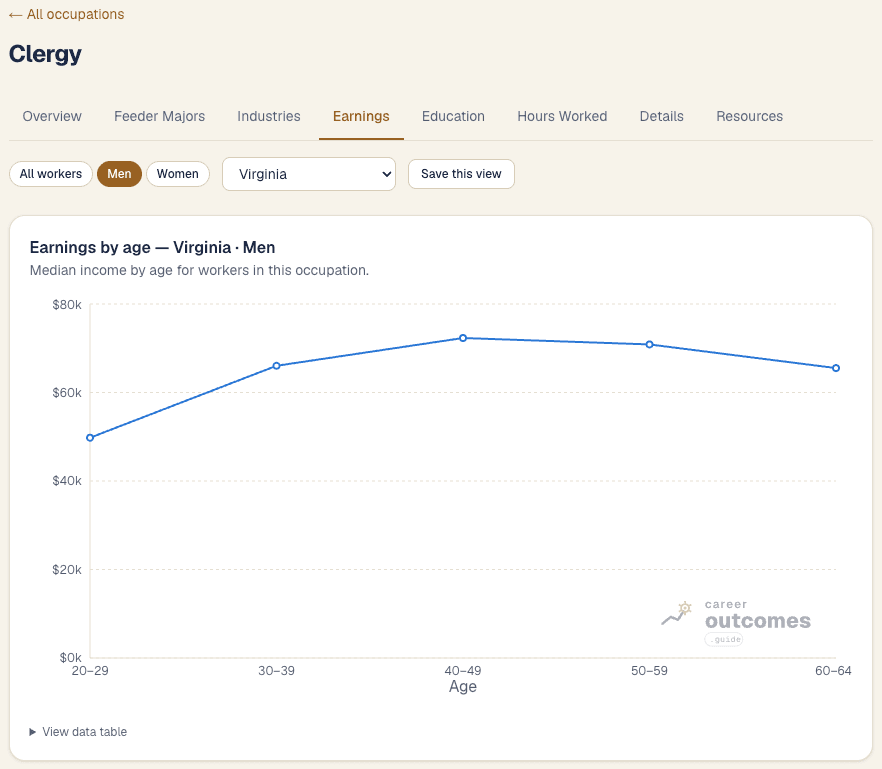
The Earnings tab displays median earnings over the career for the selected occupation, within the selected state and sex. The earnings shown are the median earnings within the shown age bin.
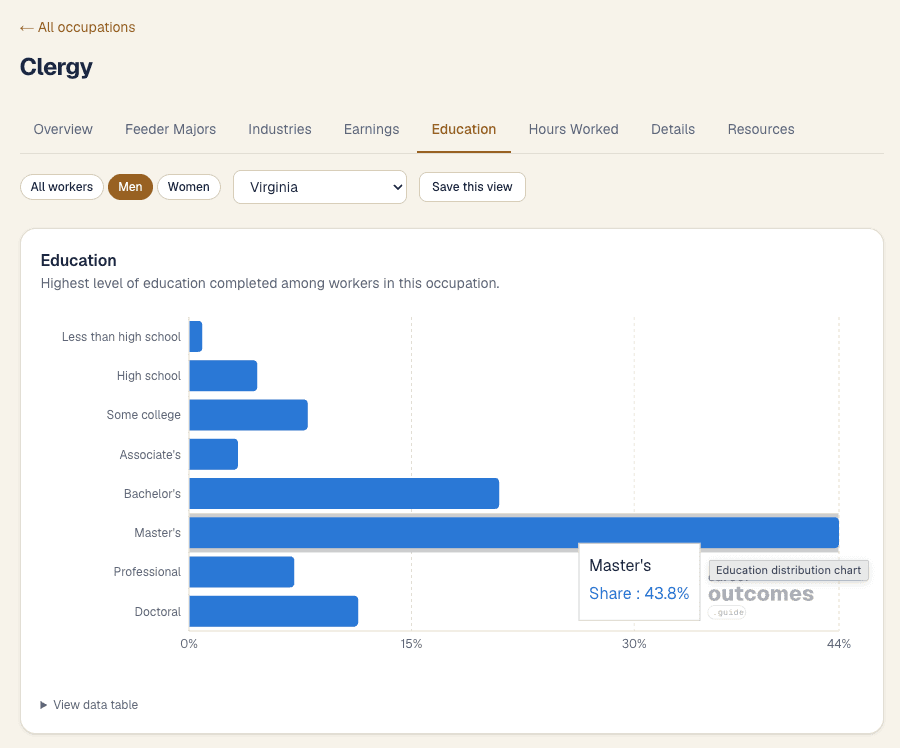
Education
The Education tab breaks down the maximum educational attainment within the occupation. These stats are enormously helpful for a student wondering whether they should go to graduate school to work in a given occupation.
Hours Worked
This tab breaks down the distribution of typical weekly hours worked. It gives users a sense of work-life balance, and how often people working in this occupation do so part-time.
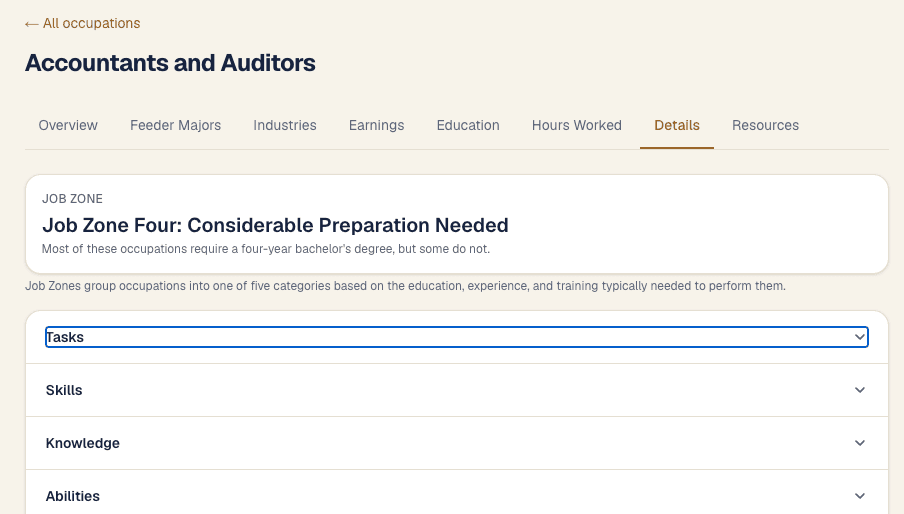
Details
The Details tab brings in O*NET data from the Department of Labor for the occupation. O*NET provides valuable information on an occupation, like key tasks, skills, work abilities, and more.
Resources
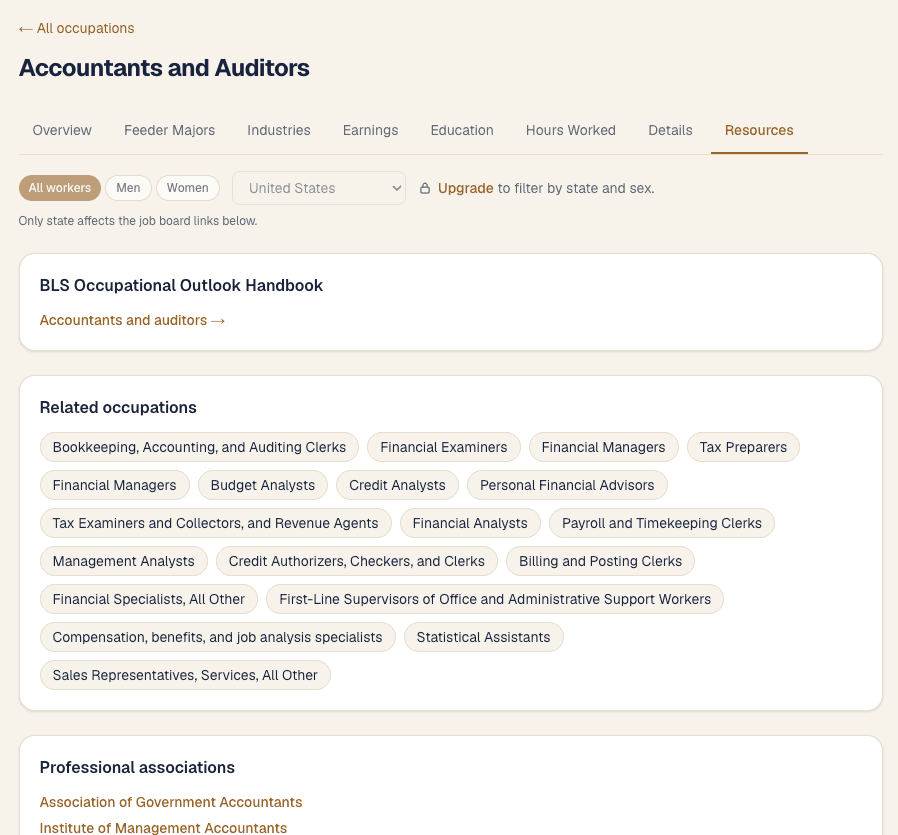
The Resources tab compiles additional helpful information, including a link to the BLS Occupational Handbook, related occupations, professional associations, and links to job boards for the selected occupation and geography.
Next
See how your interests match to occupations in the Assessment guide, or jump straight to the Occupations list.