
Majors Overview
Career Outcomes Guide's majors data brings unprecedented detail on outcomes by college major, drawn mainly from the American Community Survey (ACS) — a large, nationally representative federal survey. See Methodology for the full data-quality details.
Note: This guide is written for Pro users. Non-logged-in and free users may not have all of these features. You can get Pro access by subscribing.
Browsing majors
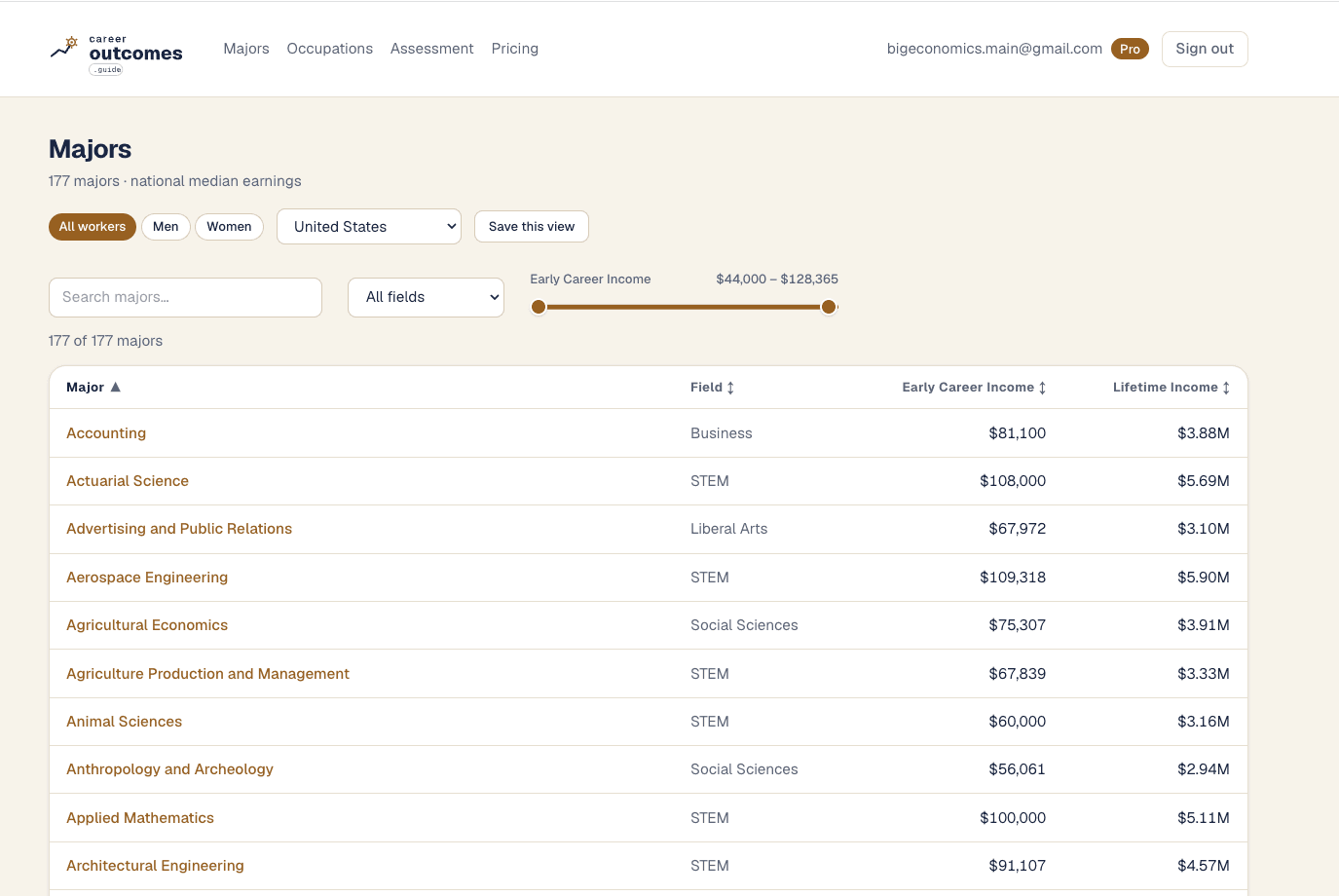
Students browse and compare majors at /majors: search across every major we cover, filter by field, sort by early-career or lifetime income, and narrow results by state and sex.
The major detail page
Selecting a major opens its detail page, organized into six tabs:
- Overview — a summary of the major's key outcomes.
- Occupations — the major's top occupations.
- Industries — the major's top industries.
- Double Majors — the majors its graduates most often report as a second field of degree.
- Earnings — earnings trajectories by age, with several comparison series.
- Trends — how degree conferrals for the major have changed over time.
Every tab can be broken down by state and sex — for example, to see the top occupations for women in Texas.
Occupations
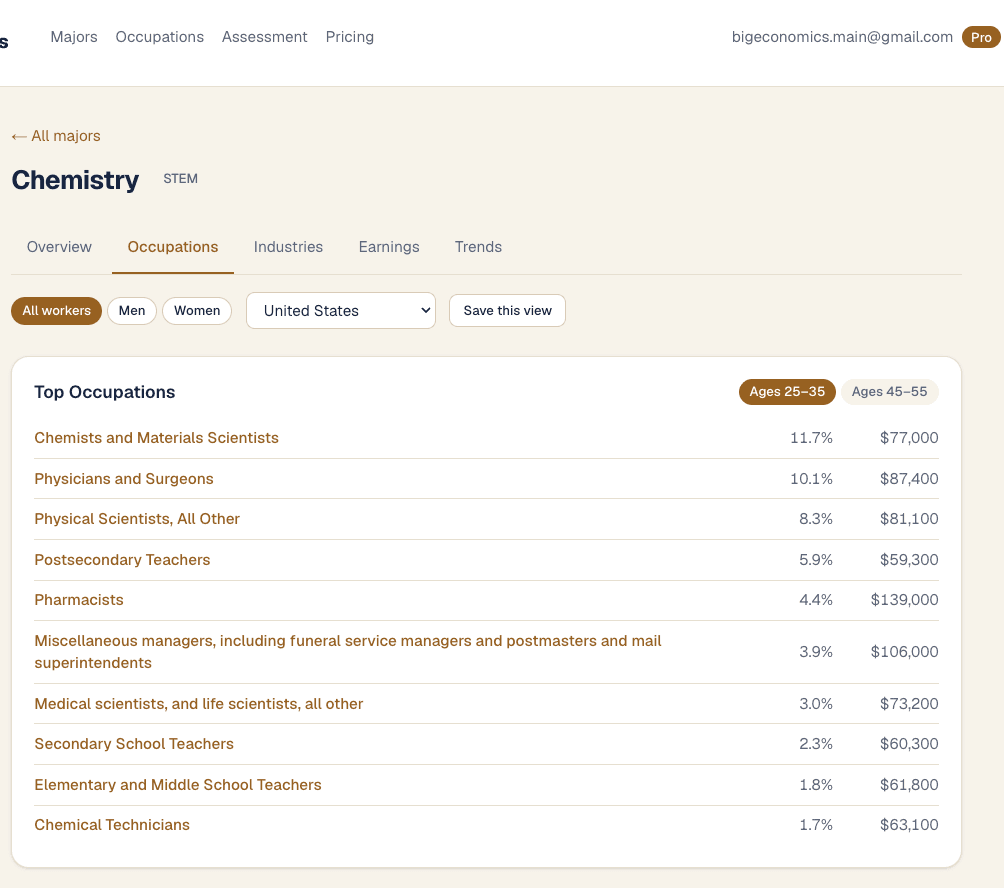
The Occupations tab breaks down the top occupations graduates go on to work in: what share of graduates work in each one, and what they earn there. Each occupation is linked to its detail page.
Industries
The Industries tab works the same way as Occupations, but broken down by industry instead: the top industries graduates work in, what share work in each, and what they earn.
Double Majors
The Double Majors tab shows the majors this major's graduates most often report as a second field of degree — what share double-majored with each one, and what those double-majors typically earn. Counted both ways, so Chemistry's list includes Biology and Biology's list includes Chemistry.
Earnings
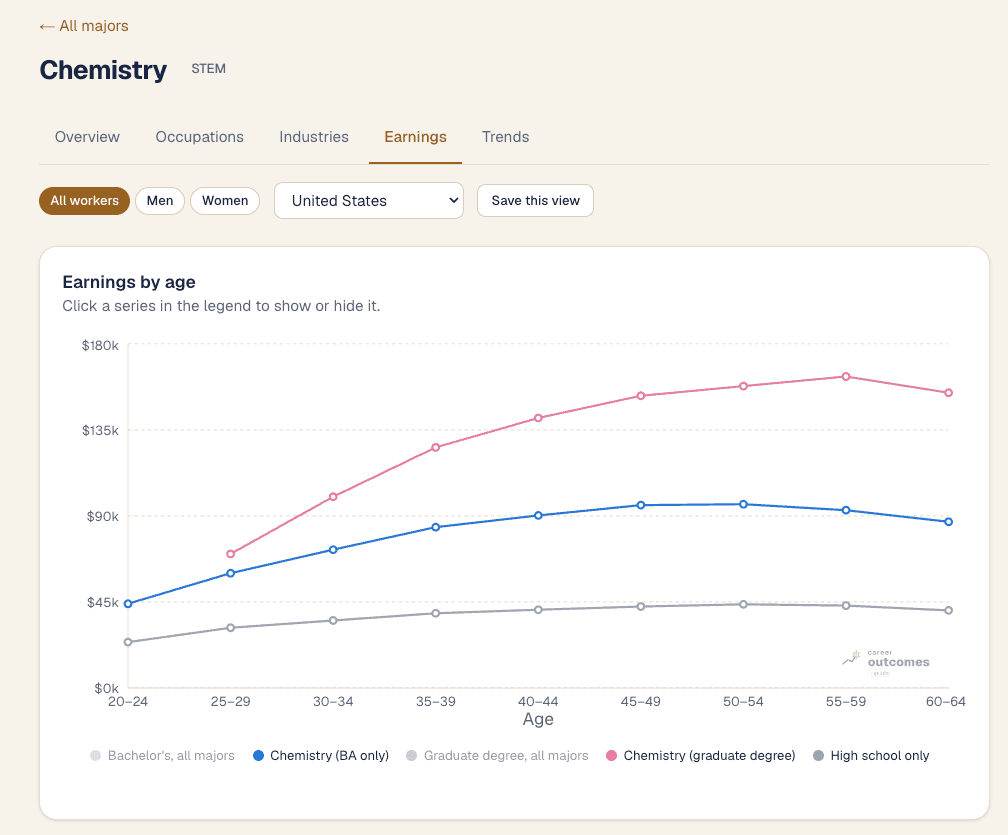
The Earnings tab plots earnings by age as a set of toggleable series:
| Series | Who's included |
|---|---|
| Bachelor's, all majors | Everyone with a bachelor's degree only, across every major |
| Graduate degree, all majors | Everyone with at least a master's degree, across every major |
| {Major} (BA only) | People with this major who stopped at a bachelor's degree |
| {Major} (graduate degree) | People with this major who went on to earn at least a master's degree |
| {Major} (BA or higher) | People with this major at any degree level, BA or graduate — shown in place of the two rows above whenever a state is selected, where there isn't enough sample to split BA-only from graduate-only for one major |
| High school only | People whose highest credential is a high school diploma |
All series respect the current state/sex selection — choosing Female/Texas, for instance, recalculates the high-school-only reference line using Texas women with a high school education only, not the national figure. Selecting any state also collapses the two major-specific series above into the single "BA or higher" line, since a state-level sample usually isn't big enough to separate BA-only from graduate-only for one major; a sex-only national selection keeps all five original lines.
Together, the series let a student make several comparisons at once: how much more a graduate degree is worth over stopping at a bachelor's, or how much a major is worth relative to not attending college at all.
Trends
The Trends tab shows how degree conferrals for the major have evolved over time, built from Department of Education data. Like every other tab, the series shown can be broken down by state and sex.
Next
See how a major connects to real jobs in the Occupations guide, or jump straight to the Majors list.